

What is the Gangaur festival?
It is a vibrant and joyful festival celebrated in Rajasthan, India. The festival is celebrated everywhere with a small or large population of the Marwari community. The Gangaur festival in Rajasthan has a special place in Jaipur’s tourist circuit.
Gangaur Festival History
It’s a festival of marital bliss or Saubhagya. It is believed that on this day, Lord Shiva blessed Goddess Parvati, his wife, with saubhagya, and Goddess Parvati blessed women with marital bliss.
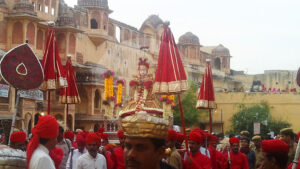
It has been celebrated in the whole of Rajasthan from prehistoric times, and religious processions are carried out on the eve of the festival in major cities like Jaipur and Udaipur.
Visit Gopinath Ji Temple in Jaipur to witness the waves of colors of celebration on Gangaur
When is Gangaur 2025?
It is celebrated in March or April month just after Holi, and it commences after the 16th day of rituals. According to the Hindu calendar, the festival is celebrated on the third day of the Shukla Paksha of the Chaitra Month.
This year, the Gangaur Festival 2026 will be celebrated from 4th March 2026 to 21st March 2026. The royal procession will take place on March 21st, and during the evening this year.
What does Gangaur mean?
It is a festival that holds deep cultural and spiritual significance. The term “Gangaur” is derived from two Sanskrit words: “Gana,” which means people, and “Gaur,” which represents Goddess Gauri, another form of Goddess Parvati. Thus, the word symbolizes the devotion and reverence of people towards Goddess Gauri and her consort, Lord Shiva. The festival is celebrated with great enthusiasm in households, reflecting the collective faith and worship of the divine couple.
What is the religious significance of the Gangaur Festival?
The festival celebrates marital bliss and devotion. Unmarried girls observe rituals for 16 days, praying to Goddess Gangaur to be blessed with a good husband. Married women participate in the festivities to seek the long life, well-being, and prosperity of their spouses. In Rajasthan, it is particularly significant for newlywed women, as they are required to observe the rituals and worship during the first year of their marriage as a cherished tradition. The festival embodies the cultural values of love, commitment, and devotion in marital relationships.
How is the Gangaur Festival celebrated?
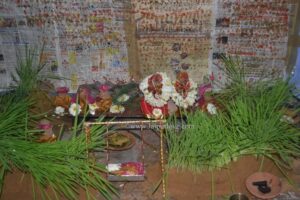
- On the next day of the Holi festival, girls and women make Isar (Shiva) and Gangaur (Paravati) from the mud of ponds. The mud statues are established with full rituals at any place in any home in the neighborhood.
- Isar and Gangaur are dressed in beautiful clothes and are worshiped using flowers, water, and grass.
- For 16 days, ladies sing melodious songs of devotion and worship Shiva Parvati in the early morning for a prosperous and happier married life.
- Ladies get ready in traditional Rajasthani clothes and ornaments.
- Newlywed girls have to wear a red Chunri (a scarf meant for a happy married life).
- In the morning, Isar and Gangaur are worshipped; in the evening, they are offered water and delicacies.
- Ladies dress younger girls as Dulha Dulhan (Bride and Groom) on the 8th day. The fest commences on the 16th day.
- On the 16th day, Isar Paravati is taken out in the form of a religious procession. Women wear colorful clothes and sing devotional songs in the procession.
- Then, Isar and Paravati are immersed in water bodies.
Where is Gangaur celebrated in Jaipur?
Jaipur’s celebrations are world-famous for their fair and royal procession. The Gangaur ki Sawari, or Ride of Gangaur processions, start from Zenana Deodhi of City Palace, where the royal family members worship Shiv and Parvati.
Then, it ends as a fair near Talkatora, traveling through Tripolia Bazar, Choti Chaupad, and Gangauri Bazar. Local artists perform dances in front of the procession. Men wearing colorful turbans or Pagdi and ladies wearing traditional Indian dresses from nearby villages also come to witness the carnival.
Jaipur’s Govind Dev Ji Temple
The best spots to see and click pictures of vibrant Mela are in Tripolia Bazar of the walled city. Sitting arrangements are made on the roof of the verandah of the market.
After the fair, people go to visit relatives and friends and eat treats. The evening before, ladies and girls get Mehandi designs on their hands and legs as a custom. That is how the Gangaur celebration in Jaipur takes place.
Gangaur Festival Recipes – Food
It is a custom to eat and distribute Jaipur’s traditional sweet Ghevar. People eat ghevar and gift it to their sisters and daughters on the eve.

Where to buy the best Ghevar in Jaipur?
Since Ghevar is mostly used during Gangor Puja and Celebration, here are the best picks of restaurants from my side.
- Lakshmi Mishthan Bhandar, Jouhari Bazar
- Sodhani Sweets, Tonk Road
- Sambhar Feeni, Jouhari Bazar
- Bombay Mishthan Bhandar, Sanganeri Gate
- Kanji Sweets, Station Road
- Sweet House, Kishanpole Bazar
Check our full guide with Map Locations to buy Ghevar in Jaipur
FAQs about Gangaur Festival Jaipur 2026
Question: What’s the best way to experience Gangaur celebrations in Jaipur as a visitor?
Answer: The best way to experience Gangaur in Jaipur is to spend time in the old city on the final day of the festival, when the grand procession takes place. Visitors who arrive early can observe rituals, traditional attire, and community participation up close, while soaking in the festive atmosphere created by folk music, decorated idols, and historic surroundings.
Question: Where are the main procession routes and celebration hubs in Jaipur?
Answer: The main Gangaur procession in Jaipur traditionally moves through the old city, passing landmarks such as Tripolia Gate and concluding near City Palace Jaipur. These areas act as major celebration hubs, attracting locals, tourists, and photographers due to their cultural importance and visual appeal.
Question: What local traditions and rituals should visitors know?
Answer: Gangaur rituals mainly involve women worshipping Goddess Gauri through fasting, prayers, folk songs, and symbolic offerings. Visitors often notice women dressed in colourful Rajasthani attire, carrying decorated clay idols, and gathering in groups, reflecting deep-rooted traditions linked to marriage, prosperity, and devotion.
Question: What makes Gangaur in Jaipur unique compared to other cities?
Answer: Gangor in Jaipur stands out because of its royal association and large-scale public procession. Unlike smaller towns where celebrations are mostly community-based, Jaipur combines palace traditions with city-wide participation, making the festival more elaborate, organised, and visually striking.
Question: What are the first-time observations and reactions to the Gangaur Festival in Jaipur?
Answer: First-time visitors often describe Gangor in Jaipur as vibrant, emotionally rich, and culturally immersive. Many are struck by the intensity of devotion, the elegance of traditional dress, and the way everyday streets transform into ceremonial spaces filled with colour, music, and collective celebration.
Did you like this info on the Gangaur festival in Rajasthan? Do like us on Facebook and read more about Jaipur.