


What is Amer Fort? – Amer Fort is a fort located in Amer Town of Jaipur, Rajasthan. Amber or Amer Fort is located high on the Aravali hills adjacent to Maotha Lake. While entering the capital city of Jaipur from Delhi via road, Amer Fort majestically welcomes everyone.
The bright yellow colored Amer Fort is the most popular tourist destination of Jaipur. Amer is famous for its rich history, mansions, heritage, and architectural monuments.
Where is Amer Fort?
Amer Fort is in the Amer town of the Jaipur district. It is 11 km away from the walled city of Jaipur, situated in the valley of the Aravali hills.
Amer is one of the three forts in Jaipur. Before Jaipur was built, Amer was the capital of the Dhundhar state. The Fort is 260 km away from Delhi by road on NH 48.
History of Amer Fort
The history of Amer Fort dates back to the 9th century. Amer was founded by Raja Alan Singh. He was from the Chanda Clan of the Meena community.
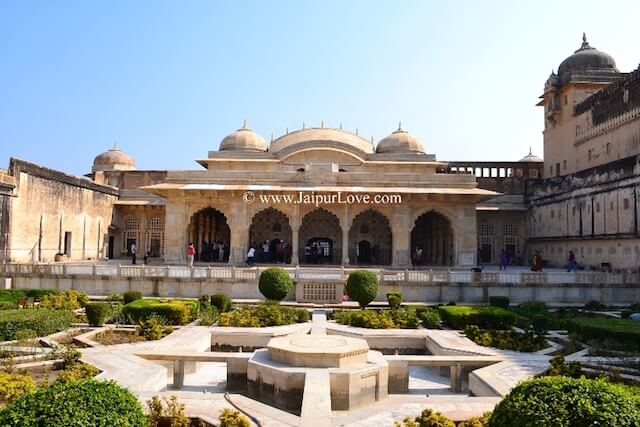
Question – When was Amer Fort built?
Answer – It is claimed by historians that Amer Fort was founded in 967 CE.
Question – Who built Amer Fort?
Answer – Although Amer Fort was founded by Meena King Alan Singh ji, what we see today is the fort built by Rajput Kachwaha kings on remnants of earlier structures.
Firstly, Amer Fort was built on remnants by Raja Man Singh of Amer. Later, Jai Singh Ji expanded much of the fort. Later successors of the Kachwaha kings expanded and improved the fort for 150 years. The first fort structure was built by Raja Kakil Dev on the present-day Jaigarh Fort.
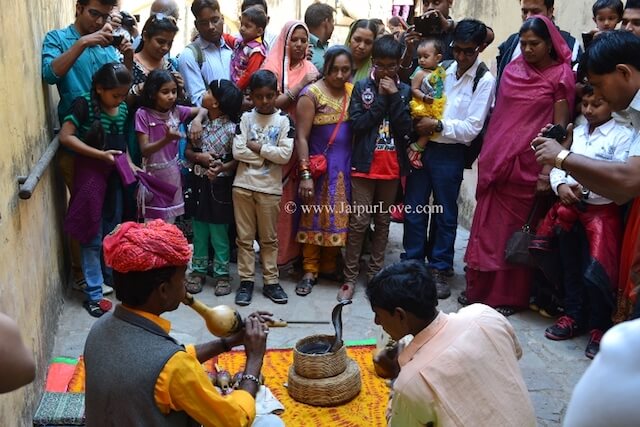
Before Jaipur, Amber was known as the Dhundhar State, and in 1036, the town was the capital of the Dhundhar State.
- 967 CE – Meena King Raja Alan Singh of the Chandra Clan founded Amber
- 1036 – The First Rajput structures were made by Raja Kakil Dev of the Kachwaha Rajput clan
- 1600 – Kachwaha King Raja Jai Singh l expanded much of the fort into its present-day structure. Ganesh Pol and Diwan-i-Khas in Amber Palace of Rajasthan were built in the era of Raja Man Singh l. And for 150 years, other successors contributed to the fort.
- 1727 AD – Jaipur was established, and the capital of the Kachwaha rulers was shifted from Amber to Jaipur.
Question – How old is Amber Fort?
Answer – Built in 967 CE, a portion of the Amber Fort Kadimi Mahal is the oldest surviving palace in India.
Amer Fort in popular culture, films, and media
Amer Fort has featured prominently in popular culture, films, and global media, becoming one of Rajasthan’s most recognizable cinematic backdrops. Its grand courtyards, ornate gates, and Rajput–Mughal architecture have been used to portray royal India in several major productions. The fort gained international visibility through the Hollywood film The Best Exotic Marigold Hotel, which showcased Jaipur’s heritage locations to a global audience. In Bollywood, Amer Fort has appeared in visually rich historical and romantic films such as Jodhaa Akbar, Paheli, and Shuddh Desi Romance, where its palaces and courtyards were used to evoke royal grandeur and old-world charm. These cinematic associations have helped Amer Fort remain not just a historical monument but also a cultural icon recognized by audiences worldwide.
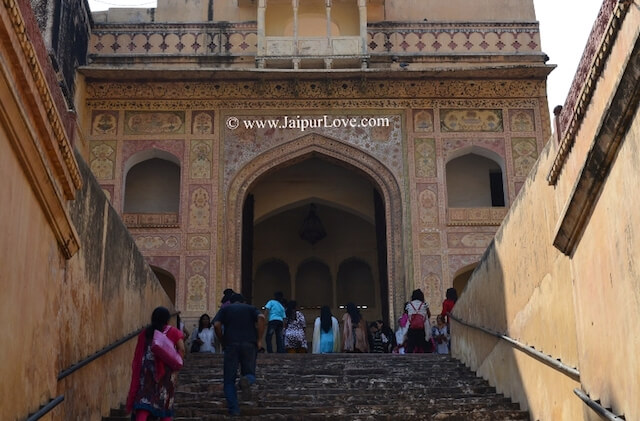
Attractions in Amber Fort
Amer is the epitome of Rajput royalty and culture. The fort is a perfect example of Rajput Military Hill architecture. Strategically built over ‘Cheel ka Teela’ (meaning home of high-flying hawks), it signifies the elevation of the fort. On one side of the fort is Maotha Lake, and other side is protected by thick forest.
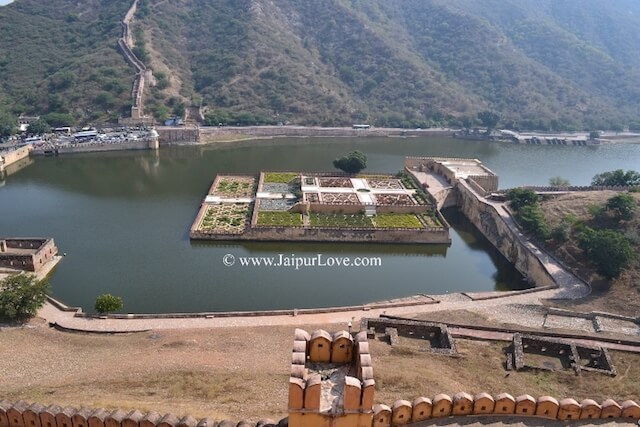
The architectural marvel of Amer Fort is made of red sandstone, marble, and big stone blocks. The bright yellow colour of the fort shines when the sun’s rays fall on it. The large fort contrasts with Maotha Lake and the surrounding thick forests.
- Suraj Pole Gate – The main entry gate to the fort is called Suraj Pole Gate, as it faces east. The huge entry gate signifies prosperity and ensures proper passage for elephants. The Suraj Pol Gate was used by armies to march in after victories in war.
- Jaleb Chowk – Jaleb Chowk in Arabic means the Army’s assembly point. Jaleb Chowk in Amer Fort was used for armies, horses, and elephants. Kings and generals used to inspect the march and received salutes from armies in this place. This is one of the four courtyards in Amer Fort.
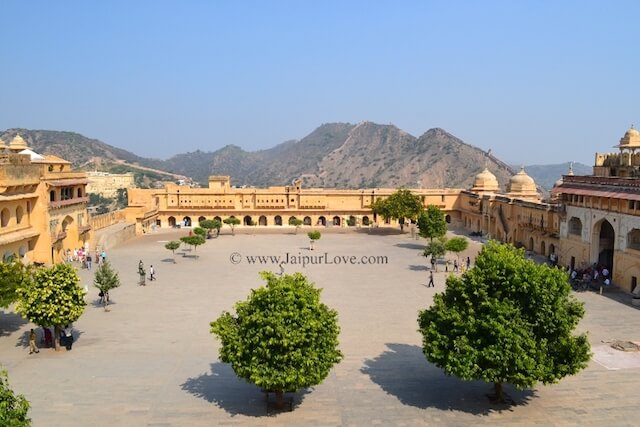
- Ganesh Pol – The courtyard of Jaleb Chowk leads to Ganesh Pol. Ganesh Pol is another fascinating gate of Amer Fort. It is painted with murals of Hindu gods. The gate is named after and dedicated to Lord Ganesh, who is the god of prosperity in Indian culture. The gate is built in Mughal Rajput style, and it is the main entry gate to the private palace in Amer Fort. Suhag Mandir above the Ganesh Pol was used by ladies of the Royal family to see ceremonies held in Diwan-i-Am through latticed windows.
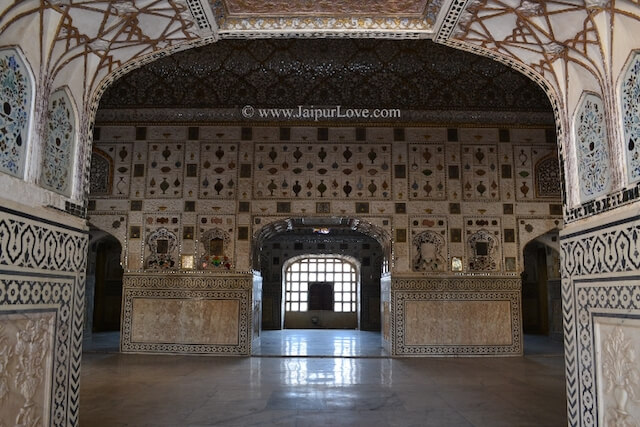
- Sheesh Mahal – Sheesh Mahal literally means Palace of Mirrors. Inside the Ganesh Pol of Amer Fort, on one side is the Sheesh Mahal. The building is covered with thousands of convex-shaped mirrors. The wall and even the ceilings are covered with mirrors, which produce glittering reflections at night. Sheesh Mahal was built by Man Singh in the 16th Century.
- Diwan-i-Am/Diwan-i-Khas – Diwan-i-Am is a public audience hall. This courtyard is built with two even columns with 27 colonnades. Diwan-i-Am was used by the king to hear grievances and petitions of the general public. Diwan-i-Khas was used for discussions with elites.
- Sila Devi Temple – Maharaja Man Singh l of Amber lost a battle against King Kedar of Pratapaditya in East Bengal. He prayed for victory to the goddess Kali. Goddess Kali blessed him in a dream, and the result was overturned. Maharaja Man Singh l established his shrine in Amber in devotion. The idol of Sila or Shila, which means stone slab, was recovered from the sea and later brought to Amber. Thus, the goddess is named Shila Mata.
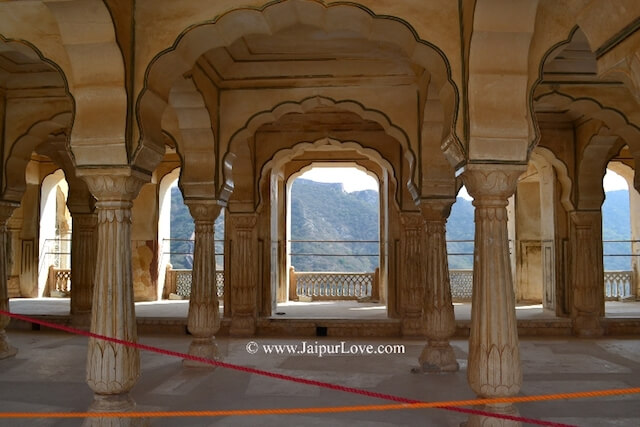
Courtyard at Amber Fort
History of Shila Mata Temple
The temple of Shila Mata was built in 1580AD. Temple is open for devotees every day from 6 in the morning to 12 in the day and from 4 pm in the evening to 8 pm.
As the Shakti is seated in the temple special puja is performed during the Navratri days. This temple is a place of religious importance to Jaipur, and thousands of devotees come to the temple during Navratri days.
Until 1980, animal sacrifice was practiced in temple before government declared it illegal by law.
Elephant ride in Amber Fort, Jaipur
The most attractive feature of the Amer Fort is the elephant ride. Riding an elephant up hill on the zigzag cobbled paths of the fort gives a lifetime memory to riders. Cow elephants are used for the ride as they are calmer than bull elephants. These decorated elephants start from downhill and drop the riders in one of the courtyards of Amer Fort.
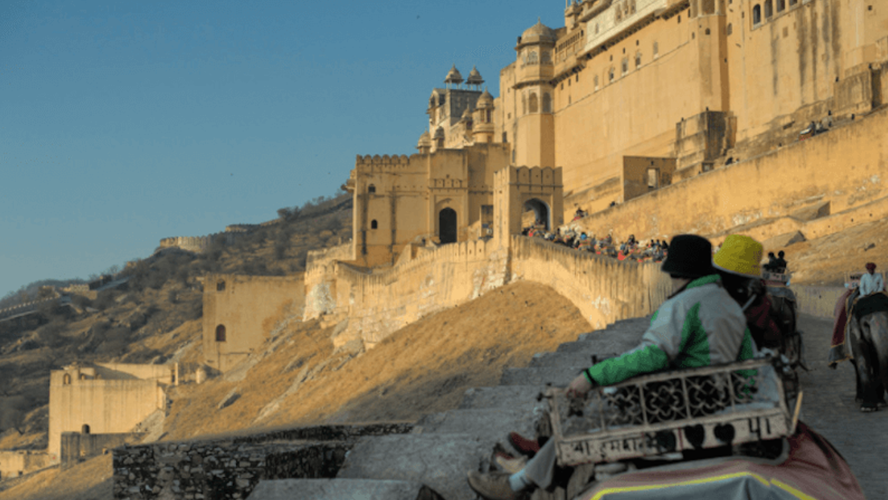
The total duration of the Elephant ride in Amer Mahal front takes from 30 minutes to 45 minutes. An elephant ride in Amer Fort costs INR 1200 per person.
There are around 80 elephants doing rides in the Amber Fort. The number of trips per elephant is fixed, and on most days, all the trips are over by 12 in day daytime.
To avoid queues and hassles, plan to reach the fort early in the morning, before 9 am, when the rides start. The cost of an elephant ride is fixed by the government.
Lately, the Government has taken initiatives to stop possible animal cruelty. Thus, every elephant needs to get regular medical checkups.
Light and Sound show in Amer Front
The government has attempted to revive the glorious past, culture, and traditions of Amer in the Light and Sound show. This attempt puts Amer Fort on the list of night tourism in Jaipur.
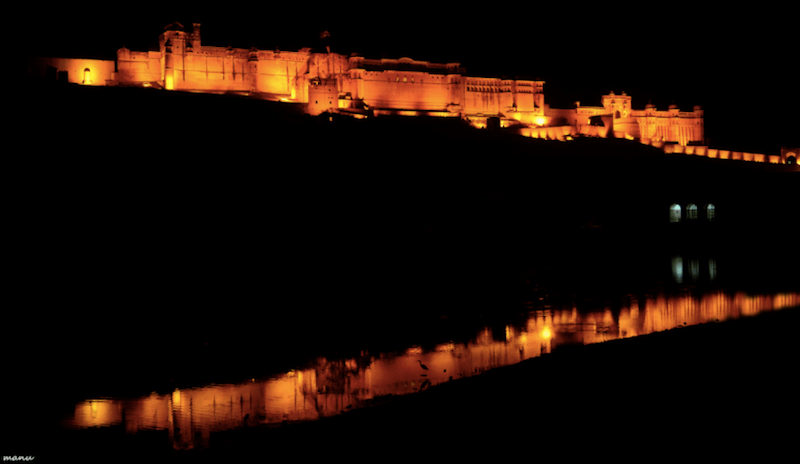
Timing of the light and sound show in Amer Fort of Jaipur:
| Amer Fort Show (Month) | Light and Sound show (English) | Light and Sound show (Hindi) |
|---|---|---|
| October to February | 6:30 PM | 7:30 PM |
| March to April | 7:00 PM | 8:00 PM |
| May to September | 7:30 PM | 8:30 PM |
Price – 295 INR for Foreigners and 100 INR for Indians
Timing of Amer Fort
Amer Fort opens for tourists at 8:30 AM and closes at 6:00 PM.
Now, cycling tours to Amer Fort are facilitated by many companies in Jaipur.
Best time to visit Amer Fort by season (month-wise guide)
- October to March (Winter Peak season): This is considered the best time to visit Amer Fort as the weather remains pleasant, with daytime temperatures suitable for long walks and exploration. October and November offer clear skies and comfortable conditions, while December and January are cooler but crowded due to holidays and peak tourist inflow. February and March balance good weather with slightly reduced crowds.
- April to June (Summer Off-season): Summers in Jaipur are extremely hot, with temperatures often crossing 40°C, making midday visits uncomfortable. If visiting during this period, early morning entry right at opening time is strongly recommended. Crowds are thinner, which can be appealing for photography, but heat management is essential.
- July to September (Monsoon Shoulder season): Monsoon brings occasional rainfall and lush surroundings around the Aravalli hills and Maota Lake, giving the fort a scenic backdrop. While humidity can be high and paths may be slippery at times, tourist numbers are moderate, and the fort appears visually striking after rains, especially for landscape photography.
- Festival and holiday periods: During major festivals, long weekends, and New Year holidays, Amer Fort experiences heavy footfall regardless of season. Visiting early in the morning or on weekdays during these periods helps avoid congestion and long entry queues.
Amer Fort map, layout, and suggested walking route
- Amer Fort layout: Amer Fort is built in a series of courtyards connected by gates, ramps, and stairways, arranged vertically along the Aravalli hills.
- Main entry route: Visitors usually enter through Suraj Pol, which opens into the large Jaleb Chowk, once used for royal military gatherings.
- Palace access: From Jaleb Chowk, the route leads through Ganesh Pol, the decorated gateway that marks entry into the private palace complex.
- Key interiors: Inside, the walking path naturally flows past Sheesh Mahal, Diwan-i-Am, Diwan-i-Khas, and residential quarters of the royal family.
- Temple stop: The Shila Devi Temple is located along the main internal route and is an important spiritual stop within the fort.
- Upper sections: Elevated corridors and terraces offer views of Maota Lake and the surrounding hills, accessed via stone stairways.
- Suggested walking route: Suraj Pol → Jaleb Chowk → Ganesh Pol → Sheesh Mahal → Diwan areas → Shila Devi Temple → ramparts and viewpoints.
- Navigation tip: Signage is limited in some areas, and distances can feel longer due to slopes and steps.
- Guided experience: To fully understand the layout, hidden passages, and historical context, a guided walking tour is highly recommended.
The JaipurLove Team can organize curated walking tours of Amer Fort, helping visitors navigate efficiently while uncovering stories and details often missed on self-guided visits.
Dress code, rules, and cultural etiquette at Amer Fort
While visiting Amer Fort, visitors are advised to dress modestly and comfortably, keeping in mind that the site includes temple areas such as the Shila Devi Temple where covered shoulders and knees are considered respectful. Comfortable footwear with good grip is recommended due to uneven stone paths, ramps, and staircases throughout the fort. Photography is generally allowed in most areas, but flash, tripods, drones, and professional video equipment may be restricted or require special permission. Visitors are expected to follow posted rules, avoid littering or touching fragile artwork, and maintain respectful behavior toward religious spaces, staff, and fellow travelers, as Amer Fort is not only a heritage monument but also a site of cultural and spiritual importance.
Amer Fort in half a day
If you’re short on time, Amer Fort can be comfortably explored in half a day with smart planning. An early-morning visit allows you to cover key highlights such as Suraj Pol, Jaleb Chowk, Ganesh Pol, Sheesh Mahal, the Diwan areas, and Shila Devi Temple in about three to four hours, while also avoiding heat and peak crowds. This compact itinerary is ideal for first-time visitors who want a meaningful experience without rushing, and a guided walk with the JaipurLove Team can help streamline the route while adding historical context that brings the fort’s stories to life.
Amer Fort + Jaigarh + Jal Mahal in one day
For travelers wanting a fuller heritage experience, combining Amer Fort, Jaigarh Fort, and Jal Mahal makes for a rewarding one-day itinerary. Start early at Amer Fort, move on to Jaigarh Fort via the ridge road or internal passage to explore its military architecture and panoramic views, and end the day at Jal Mahal for lakeside photography and sunset views. This route flows naturally without backtracking, and the JaipurLove Team can organize the entire day as a guided walking and transfer-based tour, ensuring smooth timing, local insights, and stress-free navigation.
How to reach Amer Fort?
Amer Fort is 11 KMs away from the walled city of Jaipur on the way towards Delhi. It is well-connected to most parts of Jaipur by buses, autos, and cabs. For Adventure seekers, bikes on rent in Jaipur are also available.
The most convenient way to visit Amer Fort is by renting a bike in Jaipur. These are readily available, avoid parking and traffic concerns, and are economical as well.
Nearest railway Station – Jaipur Railway Station, 21 km
Nearest Airport – Sanganer Airport, Jaipur 24.6 km
Nearest Bus Station – Sindhi Camp Bus Stand 11.2 km
Nearest Metro Station – Badi Chaupad Metro Station 7.7 km
It takes at least 2-3 hours to visit Amer Fort.
Amer Fort Ticket prices, entry passes, and online booking details
Ticket prices and entry passes for Amer Fort are regulated by Rajasthan Tourism and are structured differently for Indian and foreign visitors, with separate charges for students and additional fees for cameras or professional videography. Entry tickets are available at the fort’s main ticket counters, but travelers are encouraged to use official online booking portals linked to Rajasthan Tourism to avoid queues, especially during peak season and holidays. Online booking not only saves time but also helps visitors plan their itinerary better, as the same system is used to issue tickets for the popular Sound and Light Show held in the evening, which requires a separate pass.
| Category | Price |
|---|---|
| Indian Student | 50 INR |
| Foreign Student | 500 INR |
| Indian Tourist | 200 INR |
| Foreign Tourist | 1000 INR |
Where to eat after visiting Amer Fort?
Vegetarian food options near Amer Fort
- Kokum Bistro – Popular vegetarian café offering Indian and fusion dishes, ~0.8–1 km from Amer Fort.
- Jagdamba Rajasthani Rasoi Restaurant – Budget-friendly local Rajasthani vegetarian meals right opposite the elephant stand, very close to the fort.
- GARH the rooftop cafe – Rooftop café with vegetarian options and views near Amer, ~0.3 km away.
- Govindam Retreat – Well-loved vegetarian restaurant with high ratings, ~2-3 km from Amer Fort.
- Royal Sheeshmahal Restaurant – Multi-cuisine vegetarian and North Indian restaurant in Amer, ~0.5 km from the fort.
Non-vegetarian food options near Amer Fort
- 1135 AD – Heritage fine-dining restaurant inside the Amer Palace complex with North Indian/non-veg specialties, ~0.1 km from the fort.
- Jaipur Courtyard – Highly rated non-veg and multi-cuisine restaurant on Amer Rd, ~2–3 km from the fort.
- The Stag Rooftop Restro cafe & lounge – Casual dining with North Indian and Chinese options near Amer, ~0.3 km away.
- Namaste Rajasthan Restaurant – Popular Rajasthani restaurant with non-veg options on Amer Road, ~2–3 km from the fort.
- Jaipur Cooking – Local favourite for North Indian non-veg meals on Amer Rd, ~2–3 km away.
These suggestions include local cafes, traditional eateries, and heritage dining experiences that are easy to reach after visiting the fort, with both budget and mid-range options to suit different tastes.
FAQs about Amer Fort in Jaipur
Question: What’s the best way to get to Amer Fort, cab, auto, or public transport?
Answer: If you want the simplest, most time-efficient option, a prepaid taxi/app cab is the easiest because it drops you at the main approach without stops and is best for families, tight schedules, or mid-day heat. Autos can be cheaper for short hops but fares often vary by bargaining, and you may still need to walk some stretches depending on where they drop you. For budget travel, Jaipur’s city buses are the most economical and fairly straightforward; there are direct services commonly routed via the old city toward Amer/Amber Fort, and Jaipur’s JCTSL routes include lines that go via Jal Mahal to Amber Fort (for example, AC1 is listed on official route PDFs), though exact frequencies can vary by time of day.
Alternatively, you can rent a bike in Jaipur to reach tight spots while avoiding traffic and parking issues.
Question: Is it normal for people (like guides or sellers) to follow tourists around inside or near the fort?
Answer: Yes, around Amer Fort it’s common to be approached repeatedly by unofficial guides, touts, souvenir sellers, and “helpers,” especially near entrances, parking approach areas, and the first courtyards. This is a typical pattern at high-footfall heritage sites in India rather than a sign you’re being singled out, but it can feel intense. If you want to minimize it, use the official ticketed entry lines, be firm with a “no,” and consider using only officially authorized guides/audio guides where available instead of accepting unsolicited offers. You can check our detailed guide on how to be safe in Jaipur for suggestions.
Question: Can you explore Amer Fort at night, and are there nighttime tickets or events?
Answer: You generally cannot freely roam the fort complex at night, the way you do in daytime visiting hours, but you can visit in the evening for the Sound & Light Show (the main organized night activity). Rajasthan Tourism lists the Amber Fort Sound & Light Show timings seasonally (typically Oct–Feb: 6:30 pm English / 7:30 pm Hindi, with different timings for other months), and tickets are sold specifically for the show. Private platforms also sell tickets, but the show schedule is best confirmed against the Rajasthan Tourism listing close to your date.
Question: What’s the earliest time to visit Amer Fort to avoid crowds and heat?
Answer: Aim to be at the gate right at opening time (commonly 8:00 AM)—that’s when temperatures are lowest and tour groups haven’t fully arrived yet. If you’re visiting in winter peak months, arriving by opening matters even more because crowds build quickly after mid-morning. Many mainstream travel references list Amer Fort’s daytime visiting as starting at 8:00 AM, so planning for an 8:00 AM entry is the most reliable crowd-avoidance move.
Question: Is the elephant ride up to Amer Fort worth it or ethical and are there alternatives?
Answer: “Worth it” depends on what you value, but ethically it is controversial. Animal-welfare groups have repeatedly called for an end to elephant rides at Amer/Amber Fort, citing welfare and public-safety concerns, and there have been recent renewed calls after reported incidents. The local government regularly organizes health camps and other legal procedures to maintain the healthy environment for elephants. Operationally, the rides have also seen disruptions and policy/price changes: local reporting in 2025 noted rides resuming after a suspension and a revised official fee (reported as ₹2,500 per ride). If you want a safer, simpler alternative, most visitors choose the jeep/4×4 ride, a taxi drop, or simply walking up (especially early morning).
Question: What are the best photo spots inside Amer Fort?
Answer: The most consistently “wow” photo zones are the Ganesh Pol façade (iconic painted gateway), the Sheesh Mahal area (mirror-work ambience), the main courtyards (grand symmetry and scale), and the rampart/view corridors where you can frame the fort with the surrounding Aravalli hills. For wider “postcard” angles, many photographers also shoot Amer Fort from vantage points that include Maota Lake and the approach road bends (outside the fort, but strongly associated with the Amer Fort photo set).
Question: Are there monkeys or wildlife issues near Amer Fort?
Answer: Yes, like many hilltop forts and temple-adjacent heritage complexes in Rajasthan, you can encounter monkeys around approach areas and nearby steps/courtyards, especially where visitors carry food or drinks. Problems are usually minor but can include snatching bottles/packets or crowding around visitors who are eating. The practical rule is simple: don’t feed them, keep snacks packed away, and hold phones/glasses securely in busy spots.
Question: Is Amer Fort crowded during peak tourist seasons like December or holidays?
Answer: Yes. Amer Fort is one of Jaipur’s top draws, and December through early January (plus long weekends/holiday periods) is routinely crowded. Around New Year, Jaipur authorities have even implemented traffic restrictions and route controls on roads leading toward major tourist zones, which reflects how heavy the visitor movement can get in that period. Expect the densest crowds from late morning through afternoon; early entry is your best hedge.
Question: What nearby places should I visit after Amer Fort, like Jaigarh or Nahargarh Fort?
Answer: The best “pairing” is Jaigarh Fort, because it’s adjacent on the same ridge and fits naturally after Amer Fort with a similar time-and-distance footprint; many visitors do Amer first, then Jaigarh for views and the military-architecture contrast. Nahargarh Fort is also a favorite, especially later in the day for city views, but it’s farther and works best if you’re continuing a full fort circuit. If you want something close and quick between forts, stops near Amer commonly include the Jal Mahal viewpoint en route and other Amer-area heritage spots depending on your pace.
Question: What’s the history behind specific spots inside Amer Fort (like Ganesh Gate, Sheesh Mahal, temples)?
Answer: Amer Fort (also spelled Amber Fort) is a Rajput-era palace-fort complex associated with the Kachwaha rulers, with major construction traditionally linked to Raja Man Singh I (late 16th century) and later expansions by successors; it’s widely presented as a key heritage site in Rajasthan’s royal history. Within the complex, Ganesh Pol (Ganesh Gate) is the celebrated painted gateway that leads into the more private palace areas, while the Sheesh Mahal (Mirror Palace) is known for its reflective mirror-work decoration designed to shimmer dramatically under light. The fort complex also has important religious spaces and shrines associated with the royal household’s worship practices, which is why temple zones and festival references appear frequently in official tourism narratives and show scripts.
Comparison: Nahargarh Fort vs Amer Fort vs Jaigarh Fort
| Feature | Nahargarh Fort | Amer Fort | Jaigarh Fort |
|---|---|---|---|
| Primary Purpose | City defense & retreat | Royal residence & administration | Military defense |
| Famous For | Sunset views & city panorama | Architecture & royal grandeur | Cannons & war structures |
| Location | Aravalli hills overlooking Jaipur | Amer town outskirts | Above Amer Fort |
| Best Experience | Evening views & dining | Daytime exploration | History & engineering |
| Time Required | 1.5–2 hours | 2–3 hours | 1.5–2 hours |
Do share this useful post with your social friends and like our Facebook page. Let us know if you need any information or help traveling to Jaipur.


Kaylee Big 7 Dec 2018
This is the best Amer Fort Jaipur guide I came across. Kudos to your efforts….
Prateek Harshwal 8 Dec 2018
Glad that the article is of help to you. Explore other articles too and share them with your friends online.
Namaste. ✌
Md Salman 8 Dec 2018
The courtyard section of Amer Fort was stunning.
Vinay Singh 13 Jan 2019
Amer fort in jaipur is an experience one will relish for years to come.