


In 1727, Amber was surrounded by enemy states. On one side, it faced frequent Maratha attacks, and on the other, rising pressure from the Mughals. Under these difficult circumstances, it was nearly impossible for the Amber rulers to achieve long-term development. However, despite the turbulence, the King managed to provide a safe haven for marble moorti artists in Jaipur, ensuring that artisans and sculptors continued practicing their craft without fear. Over time, this protection laid the foundation for what later became one of India’s most thriving marble moorti Jaipur industries. Read along, as we dedicate this article to the thousands of marble sculptors of Jaipur.
Being a visionary, Sawai Jai Singh II dreamt of a city so beautiful that it would rank among the most magnificent cities in India. At the time, Amber—the capital of Dhundar—was flourishing with trade and commerce, and it became necessary for the Maharaja to lay the foundation of Jaipur in 1727. Many monuments, palaces, and forts constructed during this period were furnished with intricate marble statues, an early reflection of Jaipur’s deep association with stone artistry. This artistic legacy still influences today’s buyers who search for marble statues in Jaipur for temples, décor, and gifting.
History: Marble Sculptors of Jaipur
Even after the city was established with a vision to become a major center of arts, trade, and business, it was difficult for businessmen and artisans to relocate to a region under constant threat of war. Sawai Jai Singh II understood that for Jaipur to flourish, artists needed security and encouragement.
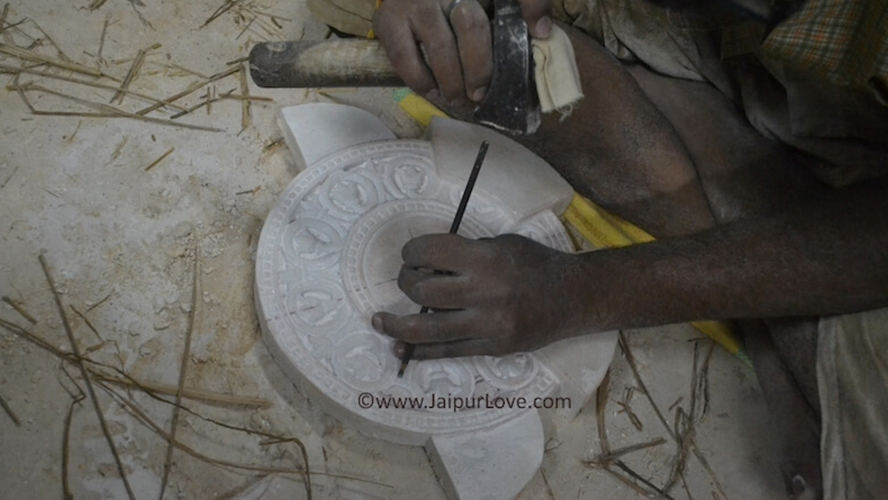
To help them relocate, he allotted land in Jaipur to artisans from different parts of India. A lover of arts himself, he frequently praised and promoted skilled craftsmen. His successors also continued this tradition. Sculptors from various regions—including Gola ka Bas, Alwar, Benaras, and even Bengal eventually settled here, especially in Khazane Walo Ka Rasta, which remains the heart of the Jaipur marble moorti market even today. Because of this long-standing support, Jaipur is now world-famous for its marble idols, marble murtis, and hand-carved sculptures.
Location – Khazane walo ka Rasta (Map link) in the walled city is where the Jaipur Moorti Market is located, attracting locals and global buyers looking to buy marble moorti in Jaipur or commission customized marble statues.
Where to buy a good quality Marble Murti?
Jaipur-made marble statues are in constant demand around the world. Customers particularly value the craftsmanship of Jaipur’s artisans, who specialize in everything from white marble moorti for home temples to large temple installations and intricate deity idols. It’s not only the statues that travel abroad—many artists themselves are invited to various countries to create fine artwork, especially for temples.
Interested in buying marble statues or sculptures straight from Jaipur’s local artists? Share your requirement in the form below and we’ll get in touch. Whether you’re looking for marble Ganesh moorti Jaipur, marble Krishna statues, or fully customized deity idols, Jaipur artisans can craft pieces tailored to your vision.
Marble Statues Jaipur Industry
The marble and stone statue industry provides direct and indirect employment to over a lakh artisans in Jaipur and the surrounding regions. Supporting businesses such as mining, logistics, and trading provides livelihood to thousands more. This makes the marble statue Jaipur ecosystem one of the largest traditional industries in Rajasthan.
With growing revenues every year, this industry faces its share of challenges. Sometimes the carving work is so intricate that even a single wrong hammer strike can destroy months of effort and lakhs worth of raw material—an unrecoverable loss. Additionally, nearly 15 to 20 percent of work suffers damage, resulting in huge monetary setbacks. Yet the pursuit of artistic perfection continues.
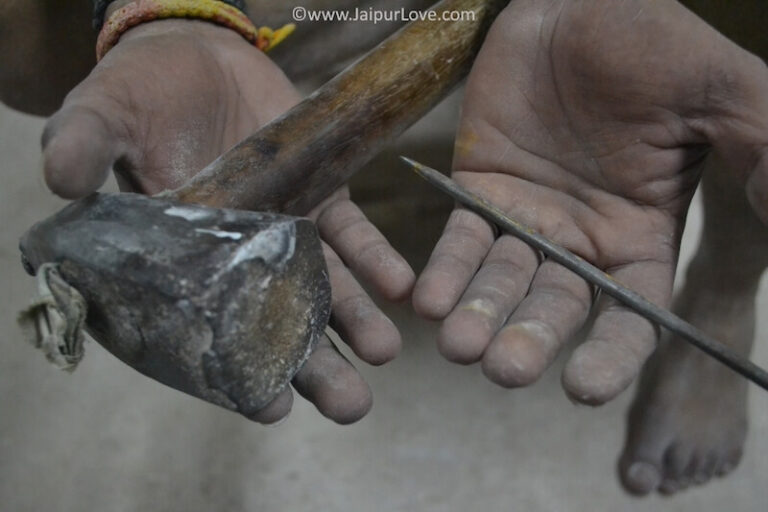
Artisans also face many health issues, often caused by prolonged exposure to marble dust. Many complain of kidney stones, lung problems, slip disc, and other ailments.
Issue – Lack of Safety Gear
Most artisans work without masks and protective gear. Fine marble-dust particles accumulate in the body and slowly affect breathing ability. In some cases, they even lead to kidney stones. Awareness regarding safety gear remains low, and it continues to be a concern for the industry.
Moorti Art Jaipur
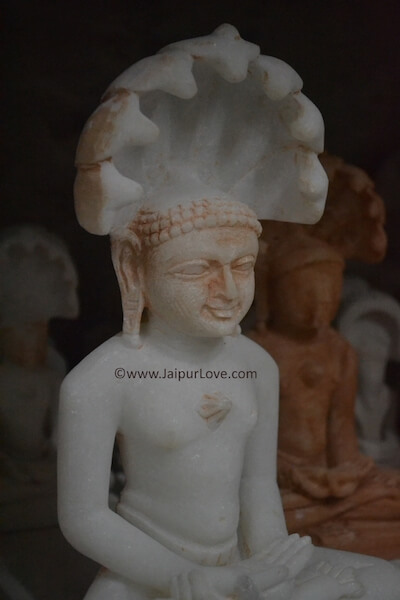
Most of the time, God Figures are in demand. This includes marble Shiv Parivar murti, Vaishnav idols, marble Ganesha statues, and Lakshmi-Ganesha murtis—especially during festivals like Ganesh Chaturthi and Diwali. During Durga Puja, demand rises sharply for Maa Durga idols, keeping artisans busy for months. These trends align with what people often search online, such as marble god statue Jaipur or marble deity idols Jaipur.
However, artistic figures also hold an important place in the market. Modern Ganesha designs, Ganesha with Rajasthani turbans, and decorative chowki-mounted idols are among the popular choices for home and office décor. Jaipur sculptors also create Bhagwan Mahaveer statues, Buddha statues, and black marble, white marble, or greenstone idols in all sizes. As a result, people looking for designer marble moorti Jaipur or custom marble sculpture Jaipur often prefer Jaipur artisans.
Jaipur Moorti Manufacturing Process
Every statue or artefact takes at least 14 days to complete, depending on size and detailing. Most of the raw stone comes from mines in Andhi, Makrana, Ambaji, and other regions. Makrana marble, in particular, is highly valued—many customers specifically search for Makrana marble moorti Jaipur because of its purity and shine. Some high-grade marble is even imported from Australia, Vietnam, and Brazil to enhance the final look.
Jaipur Statue Manufacturing Process
- Artisans first take measurements of the stone block and outline the design of the desirable statue based on imagination and experience.
- Using traditional hammer and nails, large chunks are removed to reveal the early raw form of the statue.
- Once the initial shape emerges, experienced sculptors draw precise measurements again to refine details like expressions, body curves, and limb structure.
- As days pass, the work becomes more detailed and demanding. Extracting expressions—especially the eyes—is considered the most difficult part of statue-making. Sometimes, even after 15 days of hard work, if the final result does not meet expectations, the entire piece becomes useless.
Once the final shape is ready, the statue undergoes polishing to enhance shine and color. Hand-polishing can take up to three days or more. After polishing, painters add the final touches—a process requiring absolute precision. After three days of drying, the statue is ready for shipment. Many of these statues become the pride of elite households, hotels, and corporate spaces, while others are worshipped after pran pratishtha ceremonies.
Interested in buying marble statues or sculptures straight from Jaipur’s local artists? Share your requirement in the form below and we’ll get in touch. Whether you need pure white marble statues Jaipur buyers prefer, custom deity figures, or large temple sculptures, Jaipur artisans can craft them all.
It’s amazing how some see beautiful artifacts in simple stone blocks, while for most of us, it’s just a rock.
Did you like this special coverage on JaipurLove? Follow us on Facebook and share your thoughts in the comment section below.
FAQs
Question: Where can I buy authentic marble moorti in Jaipur?
Answer: You can buy authentic marble moorti in Jaipur at Khazane Walo Ka Rasta, the city’s oldest hub for marble sculptors. Many artisans also accept custom orders for marble idols and temple statues.
Question: Which area is famous for marble statue shops in Jaipur?
Answer: Khazane Walo Ka Rasta in the walled city is widely known as the Jaipur Moorti Market. It is the most popular place for buyers searching for marble statues, marble idols, and hand-carved deity murtis.
Question: Are Jaipur marble murtis made from Makrana marble?
Answer: Yes. Many Jaipur artisans use premium Makrana marble, along with marble sourced from Andhi, Ambaji, Vietnam, and other regions. Makrana marble murtis are especially valued for their pure white finish.
Question: Can I order customized marble god statues from Jaipur?
Answer: Absolutely. Jaipur is known for custom marble god statues, including Ganesha, Krishna, Shiv Parivar, Durga, Buddha, Mahaveer, and more. Artisans can tailor size, expression, posture, and color based on your requirement.
Question: How much does a marble moorti cost in Jaipur?
Answer: The price depends on size, detailing, marble quality, and finishing. Hand-carved marble murtis can range from a few thousand rupees to several lakhs. Custom designs or larger temple statues command a higher price.
Question: Do Jaipur sculptors ship marble idols internationally?
Answer: Yes. Jaipur’s marble statue industry exports to the USA, UK, Australia, UAE, and Southeast Asia. Many buyers order custom murtis for home temples, public temples, hotels, and cultural centers abroad.
Question: How long does it take to make a marble murti in Jaipur?
Answer: A marble murti typically takes 14 days to several weeks depending on the size and level of detailing. Intricate expressions, deity ornaments, and polishing require significant skill and time.
Question: What are the most popular types of marble murtis in Jaipur?
Answer: Ganesha idols, Krishna statues, Lakshmi-Ganesha sets, Shiv Parivar murtis, Durga idols, Buddha statues, and modern decorative Ganesha figures are among the top choices. Artistic pieces are also in constant demand.
Question: Can I visit Jaipur workshops to see moorti-making in person?
Answer: Yes. Several workshops in Khazane Walo Ka Rasta and nearby localities welcome visitors. You can watch artisans carve statues by hand and understand the entire moorti-making process.



marble supplier in rajasthan 12 Jun 2019
Your work is elegant and unique, that makes you different from others, thanks for sharing wonderful info with us. keep sharing. You are the Best marble suppliers in rajasthan. so go keep doing quality work.
Prateek Harshwal 23 Jul 2019
Thanks.
Vikas Bumb 27 Jun 2019
Hi, I am Vikas Bumb a sculptor from Jaipur. I love to read your blog as a sculptor.
Thank for the information.
Prateek Harshwal 23 Jul 2019
Thanks. It is a small effort from our side to the long tradition of fine arts.
Mr. Omprakash 23 Jul 2019
Thanks for Sharing this page. its is a very useful
Prateek Harshwal 23 Jul 2019
Indeed, marble sculptors work very hard. But none seem to care about the health and other problems they face in their everyday life. Namaste.
Gaj Arts 3 Sep 2019
Nice Article…………Thanks for Sharing this Information
Somnath Sinha 15 Oct 2019
I require a Marble(vietnam) shiv statue 2 ft sitting two hands where to buy
Prateek Harshwal 17 Oct 2019
I have reached you on WhatsApp. Please provide with necessary details.
Mandar Kadam 18 Dec 2019
Nice article Prateek.. Good Info.. I am looking for 3 to 5 ft Buddha statue carved in a Marble(vietnam). Can you suggest ..
Prateek Harshwal 23 Dec 2019
Connect on 9549664111 (whatsapp)
lalit sharma 19 Apr 2020
It is a commendable step to publicise our art and to make Jaipur recognised. good work. keep it up bro
Pandey Marble Moorti 21 Dec 2020
Hello, This product and information are very amazing.
Prateek Harshwal 28 Dec 2020
Thanks. Do share the information with all your contacts online.
Art Moorti 25 Mar 2021
It very good way for good choice
Prateek Harshwal 8 Jul 2021
Thanks. Do share the article with your friends and relatives as well.